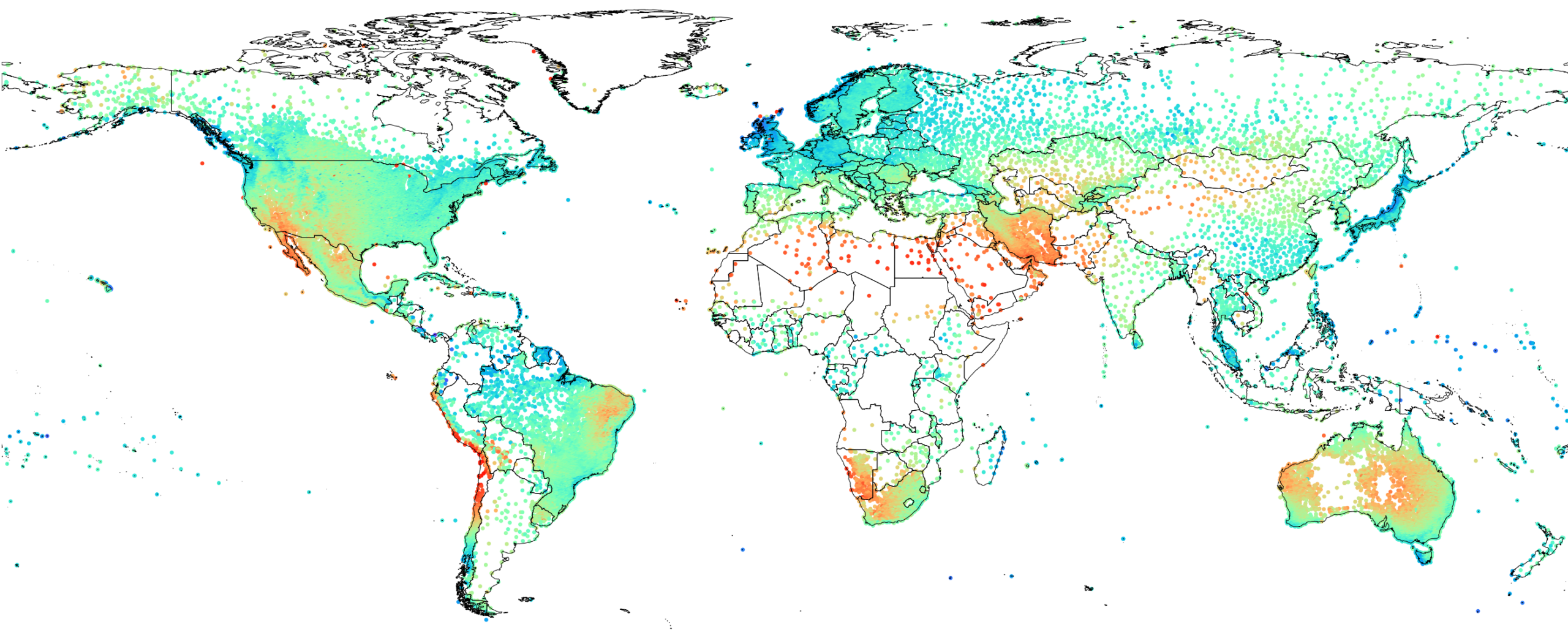
Merging gauge observations, satellite retrievals, and reanalysis outputs into one comprehensive global precipitation probability dataset.
Overview
The Precipitation Probability DISTribution (PPDIST) dataset represents a collection of global high-resolution (0.1°) observation-based climatologies (1979–2018) of the occurrence and peak intensity of precipitation at daily and 3‑hourly time scales.
The climatologies were produced using neural network ensembles and take advantage of the strengths of all three main precipitation data sources — satellites, reanalyses, and gauges — to obtain reliable estimates for the entire globe. For more information, see the following open-access paper:
Use the slider to compare the observations compare to the neural network model estimates and see the model fills the gaps.
Daily >0.5 mm precipitation occurrence (% of time)
Data access
Freely use, adapt, and share these maps under CC BY 4.0, with attribution to Beck et al. (2020).
The latest version of the PPDIST dataset can be downloaded here. The data are provided under the Creative Commons Attribution 4.0 International (CC BY 4.0) license, allowing you to freely use, adapt, and share the maps for both commercial and non-commercial purposes. You must, however, properly attribute the source by citing Beck et al. (2020) in any publication that uses the maps.
If the dataset forms a key component of your research, we kindly ask that you contact us and provide us the opportunity to provide feedback on your results prior to publication,